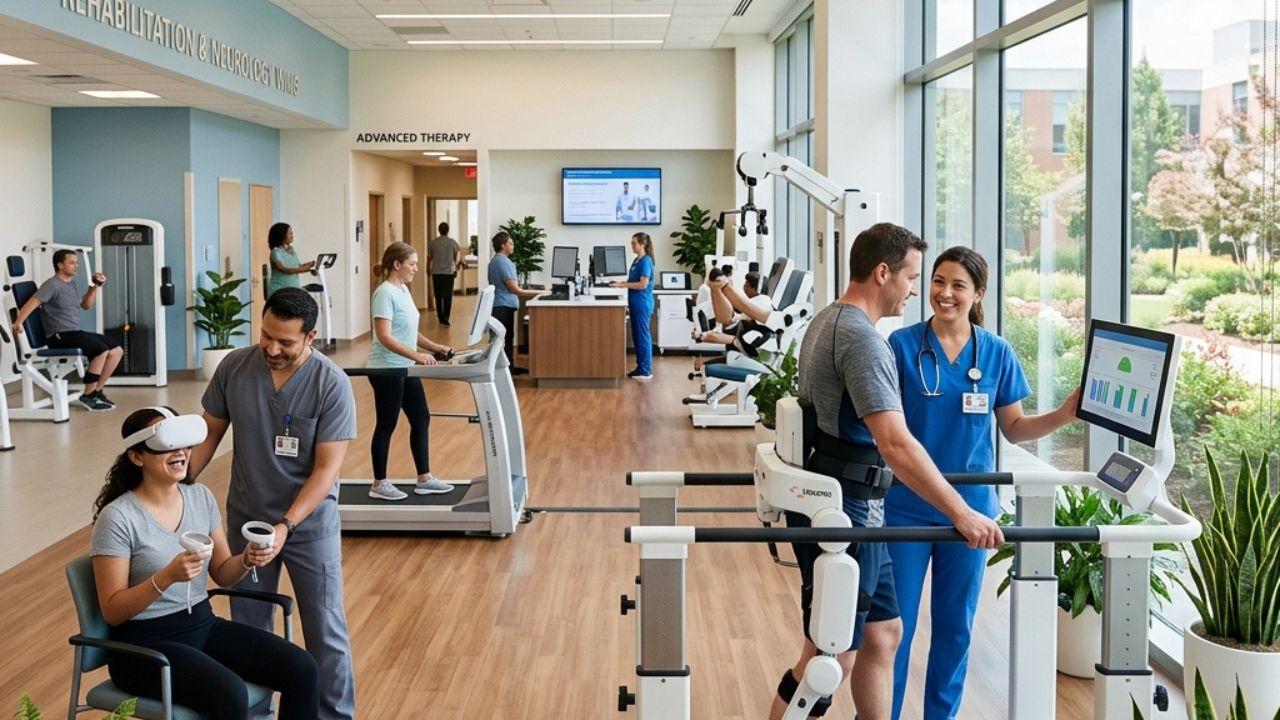
Advanced rehabilitation technology—including robotic-assisted therapy, virtual reality rehabilitation, and AI-powered diagnostics—is transforming patient recovery outcomes. Hospitals that invest in these tools consistently deliver faster recovery timelines and more personalized treatment plans. This guide identifies the top hospitals leading the charge and explains what to look for when choosing one.
Recovery is rarely linear. For patients navigating life after a stroke, spinal cord injury, traumatic brain injury, or major orthopedic surgery, the quality of rehabilitation care can determine whether they walk again, regain independence, or return to the activities they love. That’s a significant stake—and it’s precisely why the technology a hospital uses matters as much as the expertise of its clinicians.
Advanced rehabilitation technology has shifted the field in meaningful ways. Robotic exoskeletons guide paralyzed limbs through repeated movements that retrain neural pathways. Virtual reality environments simulate real-world tasks in controlled, measurable settings. AI-powered diagnostic tools analyze patient data in real time, allowing therapists to adjust treatment plans dynamically rather than waiting for weekly check-ins to reveal what’s working.
Not every hospital has embraced these innovations at the same pace. Some institutions are genuinely leading the field with purpose-built rehabilitation centers, dedicated research programs, and multidisciplinary teams trained to use cutting-edge equipment effectively. Others still rely predominantly on conventional approaches.
This guide is designed to help patients, caregivers, and healthcare professionals identify hospitals where advanced rehabilitation technology is not an afterthought—but a core part of how care is delivered. Below, you’ll find a breakdown of the key technologies reshaping rehabilitation, the criteria that separate good rehabilitation hospitals from great ones, and profiles of five institutions consistently recognized for their technological capabilities.
What Is Advanced Rehabilitation Technology—and Why Does It Matter?
What types of technologies are transforming rehabilitation today?
Advanced rehabilitation technology refers to a broad category of tools and systems that go beyond traditional physical, occupational, and speech therapy. The three most transformative categories currently in clinical use are:
Robotic-Assisted Therapy: Devices like the Lokomat (a robotic gait training system) and the Ekso Bionics exoskeleton support patients with limited mobility through guided, repetitive movements. These systems enable high-intensity training that would be physically exhausting—or impossible—to achieve manually. Research published in the Journal of NeuroEngineering and Rehabilitation has demonstrated that robot-assisted gait training can significantly improve walking speed and endurance in stroke survivors compared to conventional therapy alone.
Virtual Reality (VR) Rehabilitation: VR platforms like MindMaze and XRHealth immerse patients in simulated environments designed to rebuild motor function, balance, and cognitive skills. Because VR exercises are engaging and gamified, patients tend to practice more consistently—which matters enormously in neurological recovery, where repetition is the mechanism of change.
AI-Powered Diagnostics and Adaptive Treatment: Artificial intelligence platforms can analyze movement data captured by sensors, cameras, or wearables to quantify a patient’s progress with far more precision than visual assessment alone. These systems help clinicians identify subtle improvements or compensatory movement patterns early, allowing for more responsive treatment adjustments.
How do these technologies improve recovery timelines and outcomes?
The core advantage of advanced rehabilitation technology is its ability to increase both the intensity and the precision of therapy. Traditional rehabilitation is limited by therapist capacity—a patient might receive two or three hours of therapy per day. Robotic and AI-assisted systems can extend active therapy time, ensure consistent technique, and provide objective data that removes guesswork from clinical decision-making.
Studies have consistently shown that higher-intensity rehabilitation, initiated earlier in the recovery process, produces better outcomes. Technology makes high-intensity therapy more feasible for a broader range of patients, including those who are cognitively impaired, medically fragile, or physically unable to participate in conventional exercises.
Personalization is the other major benefit. AI systems can build individual patient profiles based on performance data, flagging plateaus and suggesting protocol changes before a therapist might otherwise notice them.
What Should You Look for When Evaluating a Rehabilitation Hospital?
What accreditations and certifications indicate quality rehabilitation care?
Accreditation from the Commission on Accreditation of Rehabilitation Facilities (CARF) is the most widely recognized benchmark in the field. CARF-accredited programs are evaluated against rigorous standards covering everything from clinical outcomes to patient rights and staff qualifications. The Joint Commission also accredits hospital-based rehabilitation programs and publishes performance data that can inform comparisons.
Beyond general accreditation, look for disease-specific certifications. A hospital treating stroke survivors should hold certification from the American Heart Association’s Get With The Guidelines program. Spinal cord injury programs should demonstrate alignment with the Model Spinal Cord Injury System of Care standards.
What equipment and facility investments signal genuine commitment to advanced rehabilitation?
Look beyond brochure-level claims. Specific equipment to ask about includes:
- Robotic gait trainers (Lokomat, Ekso, ReWalk)
- Upper extremity robotics (InMotion ARM, Armeo Power)
- VR therapy platforms with documented clinical protocols
- Functional electrical stimulation (FES) systems
- Aquatic therapy pools with adjustable resistance
- Motion capture labs for biomechanical assessment
A hospital that invests in this equipment and trains staff to use it well signals a long-term commitment to evidence-based rehabilitation, not just a marketing upgrade.
Why do staff qualifications matter as much as equipment?
Technology is only as effective as the clinicians deploying it. Ask whether therapists hold certifications specific to the technologies used—for example, training from the manufacturer of the robotic systems in use, or certification in VR-based neurorehabilitation. A hospital with a $2 million robotic system and undertrained staff will consistently underperform a hospital with a modest setup and a highly skilled, specialized team.
Multidisciplinary team composition also matters. The most effective rehabilitation programs integrate physiatrists, neurologists, physical therapists, occupational therapists, speech-language pathologists, neuropsychologists, and social workers into coordinated care plans.
How should you evaluate patient outcomes and success rates?
Request outcome data directly from the hospital’s rehabilitation department. Reliable metrics include Functional Independence Measure (FIM) scores at admission and discharge, average length of stay, discharge destination (home vs. skilled nursing facility), and readmission rates. Nationally, the Uniform Data System for Medical Rehabilitation (UDSMR) publishes benchmarking data that allows individual hospitals to be compared against national averages.
Patient testimonials provide useful context, but they shouldn’t replace outcome data. Look for both.
The Top Hospitals for Advanced Rehabilitation Technology
Shirley Ryan AbilityLab (Chicago, Illinois)
Formerly the Rehabilitation Institute of Chicago, Shirley Ryan AbilityLab consistently ranks as the number-one rehabilitation hospital in the United States according to U.S. News & World Report, a distinction it has held for over 30 consecutive years. The facility operates as a “translational research hospital,” meaning that research scientists and clinicians work side by side on the treatment floor—a model unique in the rehabilitation space.
The AbilityLab houses dedicated labs for robotics, neuroscience, and bionic medicine. Its RIC Research Center develops and tests technologies like brain-computer interfaces and soft robotic gloves. Patients benefit from access to cutting-edge treatments often unavailable elsewhere, frequently as part of clinical trials integrated into routine care.
TIRR Memorial Hermann (Houston, Texas)
TIRR Memorial Hermann ranks consistently among the top rehabilitation hospitals in the country, with particular strength in brain injury, spinal cord injury, and stroke rehabilitation. The hospital’s research arm—the TIRR Foundation—funds ongoing studies in neurostimulation, exoskeleton-assisted locomotion, and cognitive rehabilitation technology.
TIRR Memorial Hermann is affiliated with UTHealth Houston, giving patients access to academic medical resources and specialist consultations across a broad range of disciplines. The hospital is also designated as a Model Spinal Cord Injury System center by the National Institute on Disability, Independent Living, and Rehabilitation Research (NIDILRR).
Kessler Institute for Rehabilitation (West Orange, New Jersey)
Kessler Institute for Rehabilitation is one of the largest and most technologically advanced rehabilitation hospitals on the East Coast. The Kessler Foundation, its research arm, operates dedicated labs focused on stroke recovery, cognitive rehabilitation, and mobility technology.
Kessler was among the first hospitals to integrate robotic exoskeletons into clinical treatment for spinal cord injury patients and has published extensively on outcomes from these programs. The institute also maintains a strong outpatient program, ensuring continuity of advanced care beyond the acute inpatient stay.
Craig Hospital (Englewood, Colorado)
Craig Hospital is a specialty hospital devoted exclusively to the rehabilitation and research of spinal cord injury and traumatic brain injury—two of the most complex and demanding rehabilitation populations. This singular focus allows Craig to develop extraordinary depth of expertise and technology specific to these conditions.
Craig consistently ranks among the top hospitals nationally for both SCI and TBI rehabilitation. The hospital’s NeuroRecovery Network affiliation ensures patients have access to activity-based therapies supported by the Christopher & Dana Reeve Foundation. Craig’s outcomes data, published transparently on its website, reflect discharge rates to community settings that exceed national benchmarks.
Moss Rehabilitation (Elkins Park, Pennsylvania)
Moss Rehabilitation, part of Jefferson Health, has been a leader in brain injury and stroke rehabilitation for decades. The Moss Rehabilitation Research Institute conducts funded research in cognitive neuroscience and motor rehabilitation, much of which directly informs clinical protocols at the hospital.
Moss offers specialized programs in aphasia recovery, driving rehabilitation, and return-to-work, serving patients across a longer recovery arc than many acute rehabilitation hospitals. Its Drucker Brain Injury Center provides a structured, technology-supported environment for patients with moderate to severe traumatic brain injuries.
Making the Right Choice for Your Recovery
Choosing a rehabilitation hospital is a consequential decision—one that shapes not just the speed of recovery but the ceiling of what’s possible. The hospitals profiled here represent genuine leaders in the integration of advanced rehabilitation technology, but the right choice depends on your specific diagnosis, geographic location, insurance coverage, and personal priorities.
Start by confirming a hospital’s accreditation status through CARF or The Joint Commission. Request outcome data. Ask specific questions about the technologies in use and the qualifications of the staff who operate them. And if possible, arrange a facility tour before committing—how a rehabilitation team interacts with patients on the floor often reveals as much as any data set.
The technology is more capable than ever. The key is finding the team that knows how to use it.
Frequently Asked Questions
What is the difference between a rehabilitation hospital and a skilled nursing facility?
A rehabilitation hospital provides intensive, acute-level rehabilitation—typically three or more hours of therapy per day—delivered by specialized multidisciplinary teams. A skilled nursing facility (SNF) offers lower-intensity therapy in a longer-term care setting. Patients with complex rehabilitation needs generally achieve better outcomes at dedicated rehabilitation hospitals, particularly those with advanced technology programs.
How do I know if a hospital’s rehabilitation technology is genuinely effective or just a marketing claim?
Request published outcome data and ask which technologies are used in routine clinical care versus which are limited to research settings. CARF accreditation and affiliation with recognized research networks (such as NIDILRR Model Systems) are reliable indicators of evidence-based practice. Specific questions about staff training and equipment utilization rates can also reveal how deeply integrated technology is in daily care.
Does insurance typically cover advanced rehabilitation technology like robotic therapy?
Coverage varies significantly by insurer and by state. Medicare covers inpatient rehabilitation at facilities that meet its criteria for intensive therapy, but coverage for specific technologies like robotic exoskeletons or VR therapy is often determined on a case-by-case basis. Contact your insurer directly before admission and ask the hospital’s financial counselor to help clarify what is and is not covered under your plan.
Who benefits most from hospitals with advanced rehabilitation technology?
Patients recovering from strokes, traumatic brain injuries, spinal cord injuries, and complex orthopedic injuries tend to benefit most from advanced rehabilitation technology—particularly robotic-assisted therapy and AI-powered diagnostics. These populations typically require high-intensity, precisely monitored therapy over extended periods, which is where technology provides its greatest advantage.
How early in recovery should a patient access advanced rehabilitation services?
Earlier is generally better. Research consistently shows that initiating rehabilitation within 24 to 72 hours of stabilization—where medically appropriate—leads to better functional outcomes. Many of the hospitals profiled in this guide operate acute inpatient programs designed to begin advanced rehabilitation as early as possible in the recovery process.