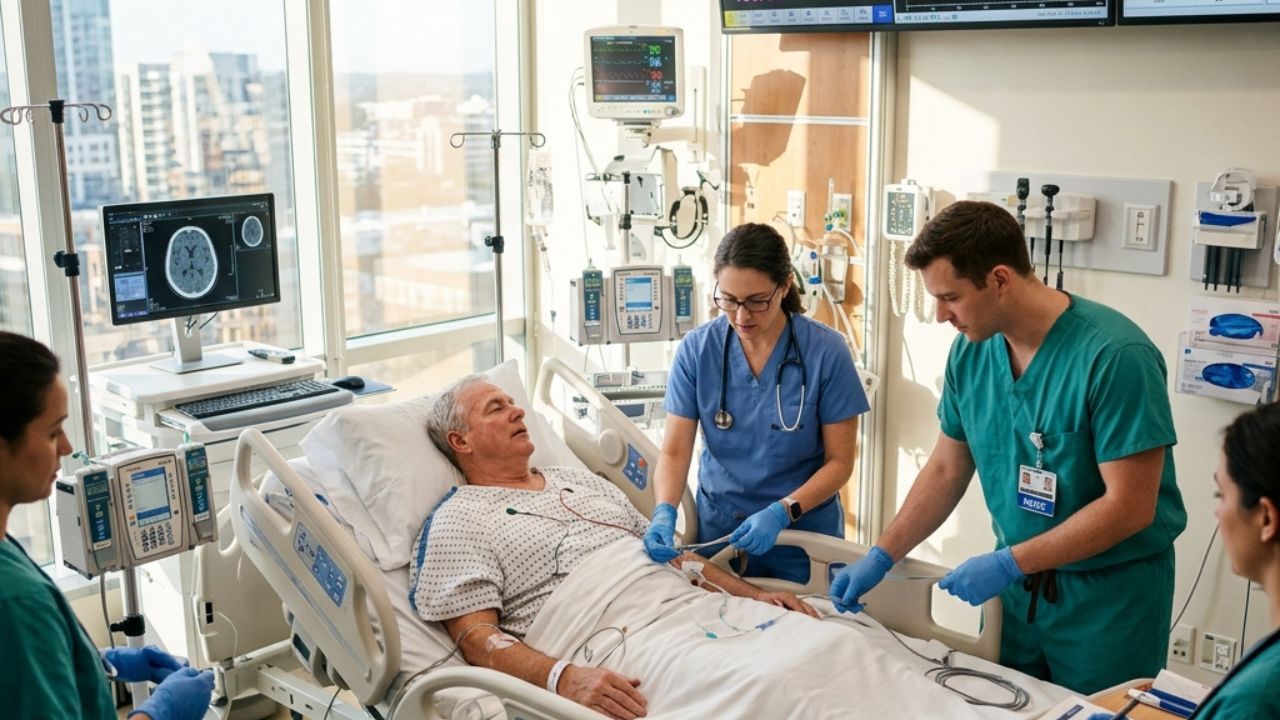
The best stroke hospitals in the USA are certified Comprehensive Stroke Centers (CSCs), offering 24/7 access to neurologists, advanced imaging, clot-busting drugs (tPA), and endovascular surgery. Top-rated institutions include Mayo Clinic, Johns Hopkins Hospital, and Cleveland Clinic. When stroke symptoms appear, call 911 immediately—every minute without treatment costs nearly 2 million brain cells.
Every 40 seconds, someone in the United States has a stroke. Every 3.5 minutes, someone dies from one. Stroke is the fifth leading cause of death in the country and a top driver of long-term disability—yet up to 80% of strokes are preventable, and fast, specialized treatment dramatically improves survival and recovery outcomes.
When a stroke strikes, the hospital you reach—and how quickly you reach it—can determine whether you walk out on your own or face a lifetime of neurological impairment. Not all hospitals are equipped equally for stroke care. The difference between a general emergency room and a certified Comprehensive Stroke Center (CSC) can mean the difference between full recovery and permanent disability.
This guide is designed for patients, caregivers, and families who want to understand what separates elite stroke care from average care, which hospitals consistently rank at the top for stroke treatment in the USA, and what steps to take the moment symptoms appear. Whether you’re planning ahead or facing an emergency right now, this information could save a life.
Understanding Stroke Types and Why Treatment Differs
Before identifying top hospitals, it’s important to understand that not all strokes are the same—and treatment approaches differ significantly based on stroke type.
What is the difference between ischemic and hemorrhagic strokes?
Ischemic strokes account for approximately 87% of all strokes, according to the American Stroke Association. They occur when a blood clot blocks an artery supplying blood to the brain. Treatment typically involves administering tissue plasminogen activator (tPA)—a clot-dissolving medication—within 4.5 hours of symptom onset, or performing a mechanical thrombectomy (surgical clot removal) within 24 hours for eligible patients.
Hemorrhagic strokes occur when a blood vessel in the brain ruptures and bleeds. These are less common but often more severe. Treatment focuses on controlling the bleeding, reducing brain pressure, and in some cases, surgical intervention. tPA, which is used for ischemic strokes, is contraindicated for hemorrhagic strokes—making accurate, rapid diagnosis essential.
A third category, transient ischemic attacks (TIAs) or “mini-strokes,” cause temporary symptoms and no permanent damage, but they are serious warning signs. According to the CDC, about 10–15% of people who experience a TIA will have a full stroke within three months.
Why do specialized stroke centers produce better outcomes than general hospitals?
Certified stroke centers have protocols, personnel, and technology specifically organized around minimizing “door-to-needle” time—the time between hospital arrival and treatment administration. The American Heart Association recommends a door-to-needle time of 60 minutes or less for tPA administration. Comprehensive Stroke Centers consistently outperform general hospitals on this benchmark.
CSCs offer round-the-clock access to stroke neurologists, advanced neuroimaging (MRI, CT angiography), neuro-intensive care units, and surgical teams trained in endovascular procedures. They also participate in national stroke registries, meaning their outcomes are continuously measured and benchmarked.
The Joint Commission certifies stroke centers at three levels: Primary Stroke Centers (PSCs), Thrombectomy-Capable Stroke Centers (TCSCs), and Comprehensive Stroke Centers (CSCs)—with CSCs representing the highest tier of care.
What Makes a Hospital a Top-Tier Stroke Treatment Center?
Ranking stroke hospitals isn’t just about reputation. The most meaningful indicators of stroke care quality include:
- Door-to-needle time: How quickly tPA is administered after arrival
- Door-to-puncture time: How quickly mechanical thrombectomy is initiated
- Stroke mortality rates: Adjusted for patient demographics and stroke severity
- Rehabilitation integration: Access to physical, occupational, and speech therapy beginning within 24 hours
- Telestroke capabilities: Remote neurologist access for rural or satellite facilities
- Research and clinical trials: Access to cutting-edge treatments not yet widely available
- Patient volume: High-volume stroke centers typically achieve better outcomes due to greater clinical experience
Top Hospitals for Stroke Treatment in the USA
The following hospitals consistently appear among the highest-rated stroke centers in national rankings, including U.S. News & World Report’s Best Hospitals for Neurology & Neurosurgery.
Mayo Clinic (Rochester, MN; Jacksonville, FL; Phoenix, AZ)
Mayo Clinic is routinely ranked as the top hospital in the United States overall, and its neurology and neurosurgery programs consistently lead national rankings. Mayo’s stroke program offers a fully integrated care model—from emergency intervention through long-term rehabilitation—with dedicated stroke neurologists available around the clock. Mayo also operates one of the country’s most active stroke research programs, offering patients access to clinical trials for novel therapies.
Johns Hopkins Hospital (Baltimore, MD)
Johns Hopkins is widely regarded as one of the nation’s premier academic medical centers, and its Comprehensive Stroke Center is among the most specialized in the country. Johns Hopkins neurosurgeons pioneered several modern techniques for treating cerebral aneurysms and arteriovenous malformations (AVMs)—two leading causes of hemorrhagic stroke. The center also operates a dedicated Cerebrovascular Center for patients with complex or recurrent stroke.
Cleveland Clinic (Cleveland, OH)
Cleveland Clinic’s Cerebrovascular Center is a Joint Commission-certified Comprehensive Stroke Center with consistently strong performance metrics. The clinic’s multidisciplinary team includes vascular neurologists, neurosurgeons, neuroradiologists, and rehabilitation specialists who collaborate on individualized care plans. Cleveland Clinic also ranks highly for post-stroke rehabilitation, a critical but often overlooked component of stroke care.
UCSF Medical Center (San Francisco, CA)
The University of California San Francisco Medical Center is home to one of the West Coast’s most respected stroke programs. UCSF’s Neurovascular Service specializes in both acute stroke intervention and the management of complex cerebrovascular conditions. The center is also a leading site for stroke research, contributing significantly to national guidelines on stroke prevention and treatment.
New York-Presbyterian Hospital / Columbia University Irving Medical Center (New York, NY)
New York-Presbyterian’s Comprehensive Stroke Center is one of the busiest and most experienced in the country, treating some of the most complex stroke cases referred from across the northeastern United States. The hospital’s collaboration with Columbia University provides access to leading stroke researchers and experimental treatments. Stroke coordinators are embedded throughout the emergency and inpatient teams to accelerate care delivery.
Northwestern Memorial Hospital (Chicago, IL)
Northwestern’s Comprehensive Stroke Center consistently ranks among the top neurology programs nationally. The hospital was an early adopter of telestroke technology and has worked to extend high-quality stroke care to patients in underserved communities across Illinois. Northwestern also has one of the country’s most robust stroke prevention clinics for high-risk patients.
Massachusetts General Hospital (Boston, MA)
Affiliated with Harvard Medical School, Massachusetts General Hospital’s Stroke Service is a leader in both acute stroke treatment and cerebrovascular research. The hospital’s research teams have contributed to landmark clinical trials that shaped current stroke treatment protocols. MGH also offers a specialized Young Stroke Program, recognizing that stroke in adults under 50 requires distinct clinical and psychosocial support.
Recognizing Stroke Symptoms: Act FAST
Knowing which hospitals excel at stroke treatment matters—but only if you act quickly enough to get there. The acronym FAST remains the most widely used tool for identifying stroke symptoms:
- Face drooping: Is one side of the face drooping or numb? Ask the person to smile. Is it uneven?
- Arm weakness: Is one arm weak or numb? Ask the person to raise both arms. Does one drift downward?
- Speech difficulty: Is speech slurred or strange? Ask the person to repeat a simple phrase.
- Time to call 911: If you observe any of these signs, call 911 immediately.
Additional symptoms include sudden severe headache (often described as “the worst headache of my life”), sudden vision loss in one or both eyes, sudden loss of coordination or balance, and sudden confusion or trouble understanding speech.
Do not drive yourself or the patient to the hospital. Paramedics can begin assessment and alert the hospital before arrival, reducing door-to-needle time significantly.
How to Identify Top Stroke Centers Near You
Identifying a certified stroke center in your area before an emergency occurs is a smart step every family should take. Here are three practical resources:
- The Joint Commission’s Stroke Center Locator: Available at jointcommission.org, this tool allows you to search for certified stroke centers by zip code and certification level.
- The American Stroke Association’s Stroke Center Finder: Found at stroke.org, this tool also includes contact information for certified centers.
- Your state’s Department of Health: Many states maintain updated lists of certified stroke receiving centers as part of their emergency medical services (EMS) protocols.
Save the address of your nearest CSC in your phone’s contacts now. In an emergency, seconds matter.
What Happens After a Stroke: The Importance of Rehabilitation
Surviving a stroke is the first milestone. Recovery is the longer journey. According to the National Stroke Association, approximately 10% of stroke survivors recover almost completely, 25% recover with minor impairments, 40% experience moderate-to-severe impairments requiring special care, and 10% require care in a nursing home or long-term facility.
Rehabilitation outcomes are strongly tied to how quickly therapy begins. The American Heart Association recommends initiating rehabilitation within 24 hours of stroke stabilization where possible. Top-rated stroke hospitals integrate rehabilitation teams—physical therapists, occupational therapists, speech-language pathologists, and neuropsychologists—directly into the acute care environment, so recovery begins before discharge.
Post-discharge, patients are typically referred to inpatient rehabilitation facilities (IRFs), outpatient therapy programs, or home-based care depending on the severity of impairments.
Know Your Stroke Risk, Know Your Options
Stroke doesn’t always announce itself in advance. But understanding your personal risk factors—hypertension, atrial fibrillation, diabetes, smoking, high cholesterol, and family history—allows you to work with your physician on prevention strategies before a crisis occurs.
For those already managing elevated risk, connecting with a stroke prevention clinic at a certified Comprehensive Stroke Center can provide access to specialist monitoring, medication optimization, and early intervention protocols.
The hospitals outlined in this guide represent the country’s highest standard of stroke care. Knowing their names and locations, recognizing stroke symptoms early, and calling 911 without hesitation are the most powerful tools at your disposal. Take a moment today to identify the nearest certified stroke center to your home and workplace. That single action, taken now, could make all the difference when every second counts.
Frequently Asked Questions About Stroke Treatment in the USA
What is a Comprehensive Stroke Center and how does it differ from a Primary Stroke Center?
A Comprehensive Stroke Center (CSC) is the highest level of stroke certification issued by The Joint Commission. CSCs provide the full range of stroke treatments, including mechanical thrombectomy, neurosurgery, and neuro-intensive care. Primary Stroke Centers (PSCs) handle less complex cases and may transfer patients requiring advanced intervention to a CSC.
How quickly does stroke treatment need to begin for the best outcomes?
For ischemic strokes, tPA should be administered within 4.5 hours of symptom onset, with better outcomes when given sooner. Mechanical thrombectomy can be effective within 6–24 hours depending on imaging criteria. The phrase “time is brain” reflects the fact that approximately 1.9 million neurons are lost every minute during an untreated ischemic stroke, according to the American Heart Association.
Is it better to go to the nearest hospital or the best-rated stroke center?
In most cases, go to the nearest hospital first—especially if you are outside the treatment window for delays. Paramedics can alert emergency teams en route, and primary stroke centers can stabilize patients and arrange rapid transfer to a CSC if needed. Delaying to travel to a higher-rated center is generally not recommended unless you are very close to one.
Does health insurance affect access to top stroke centers?
Insurance type can affect which hospitals are in-network, but emergency stroke care must be provided regardless of insurance status under the Emergency Medical Treatment and Labor Act (EMTALA). Billing and coverage discussions can happen after stabilization. If you are concerned about access, contact the hospital’s patient services team post-emergency.
Can stroke recovery be complete?
Full recovery is possible, particularly for mild strokes identified and treated quickly. The extent of recovery depends on which area of the brain was affected, the severity of the stroke, the speed of treatment, and the quality and intensity of rehabilitation. Early, consistent therapy significantly improves long-term outcomes.