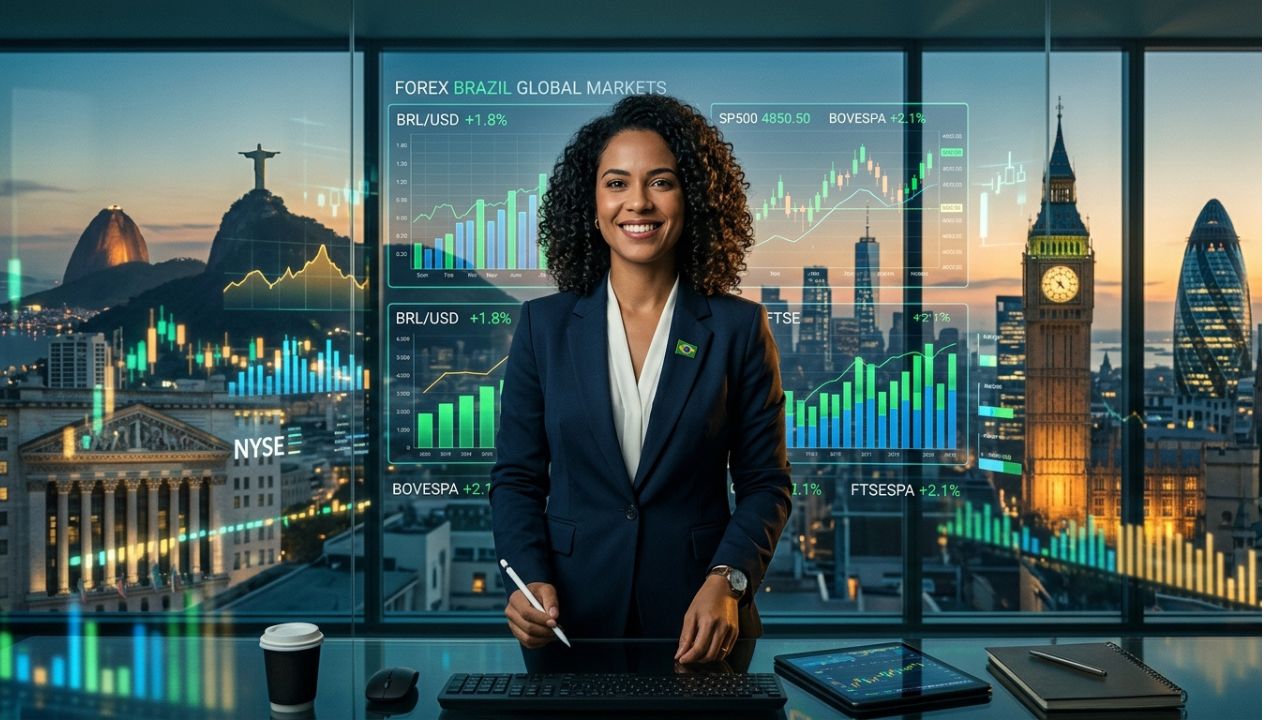
Forex trading involves buying and selling currency pairs to profit from exchange rate movements, while global investing allows Brazilian investors to access international assets like US stocks and bonds. Together, these strategies help diversify portfolios beyond the Brazilian real and local markets, reducing exposure to domestic economic volatility and currency risk.
Brazilian investors have historically kept the bulk of their portfolios close to home, concentrated in local equities, government bonds, and real estate. That approach made sense when capital controls were tighter and international access was limited to large institutions. Today, the landscape looks different. Digital brokerages, currency trading platforms, and global investment products have made it possible for everyday Brazilian investors to look beyond their borders.
This shift matters because the Brazilian real has experienced significant volatility against major currencies over the past decade, driven by factors ranging from domestic political uncertainty to shifts in global commodity prices. For investors holding assets exclusively in reais, this volatility translates directly into purchasing power risk. Understanding how forex markets function, and how global investing fits alongside it, has become a practical necessity rather than a niche interest.
This guide breaks down the fundamentals of forex trading, explores the growing appetite among Brazilian financial professionals for international exposure, and outlines why currency market literacy is a cornerstone of modern portfolio diversification.
What Is Forex Trading and How Do Currency Markets Work?
Forex trading, short for foreign exchange trading, is the process of buying one currency while simultaneously selling another. The goal is to profit from changes in the exchange rate between the two currencies. Unlike stock exchanges, the forex market has no central physical location. It operates as a decentralized global network of banks, financial institutions, and individual traders, with trading happening around the clock across different time zones.
Currencies are always traded in pairs because the value of one currency is only meaningful relative to another. When a trader buys the USD/BRL pair, for example, they’re speculating on whether the US dollar will strengthen or weaken against the Brazilian real. If the dollar appreciates relative to the real, a long position on USD/BRL gains value.
Exchange rates fluctuate constantly based on a mix of economic data, interest rate decisions, political developments, and market sentiment. For Brazilian investors, this means that currency movements are rarely random. They often reflect shifts in Brazil’s own macroeconomic indicators, such as the Selic interest rate, inflation figures, and fiscal policy announcements, as well as developments abroad.
Who Are the Key Players in the Forex Market?
The forex market includes several categories of participants, each with different motivations and levels of influence.
Central banks, including the Banco Central do Brasil and the US Federal Reserve, play an outsized role in currency valuation. Their decisions on interest rates and monetary policy directly affect how attractive a currency is to hold. When the Federal Reserve raises interest rates, for instance, the US dollar often strengthens as global capital flows toward higher-yielding dollar-denominated assets.
Financial institutions, such as commercial banks and investment firms, account for the largest share of daily forex trading volume. These institutions trade currencies on behalf of clients, manage currency risk for multinational businesses, and engage in proprietary trading strategies.
Retail traders represent individual investors who trade currencies through online brokerages. While retail trading volume is smaller than institutional activity, this segment has grown substantially as trading platforms have become more accessible and affordable for everyday investors, including those in Brazil.
Which Currency Pairs Matter Most for Brazilian Investors?
For Brazilian investors, certain currency pairs carry particular significance.
USD/BRL is the most closely watched pair, given the US dollar’s role as the world’s reserve currency and Brazil’s trade relationship with the United States. Movements in this pair directly affect the cost of imported goods, international travel, and dollar-denominated investments.
EUR/BRL matters for those with exposure to European markets or businesses, while EUR/USD, the most heavily traded pair globally, serves as a benchmark for broader currency market sentiment that can indirectly influence the real.
Monitoring these pairs gives Brazilian investors insight into broader capital flow trends, helping them anticipate how shifts in global risk appetite might affect their local investments.
What Are the Global Investing Opportunities for Brazilian Investors?
Forex trading is one way to engage with currency markets, but global investing offers a broader set of tools for building an internationally diversified portfolio. Rather than actively trading currency pairs, global investing typically involves holding foreign assets, such as stocks, bonds, or funds, that provide indirect currency exposure alongside potential capital appreciation.
Why Does International Diversification Matter for Brazilian Portfolios?
Diversification is a foundational investing principle: spreading capital across different assets reduces the impact of any single investment’s poor performance on the overall portfolio. For Brazilian investors, this principle extends naturally to geography and currency.
Brazil’s economy is heavily influenced by commodity exports, particularly agricultural products, iron ore, and oil. This makes Brazilian equity markets and the real sensitive to global commodity price cycles. A portfolio concentrated entirely in Brazilian assets inherits this sensitivity, even if individual holdings are well-chosen.
By allocating a portion of a portfolio to international assets, Brazilian investors can reduce their dependence on domestic economic cycles. If the Brazilian economy slows or the real depreciates sharply, foreign-denominated holdings can help cushion the overall impact on portfolio value. This doesn’t eliminate risk, since international markets carry their own volatility, but it changes the nature of that risk from a single-economy exposure to a more distributed one.
How Can Brazilian Investors Access US Stock Markets?
The United States hosts the largest and most liquid equity markets in the world, home to companies like Apple, Microsoft, and Amazon that have limited direct equivalents on Brazil’s B3 exchange. For Brazilian investors looking to diversify, US equities are often the first stop.
There are a few common paths to accessing these markets. Brazilian investors can open accounts with international brokerages that support direct trading of US-listed stocks and exchange-traded funds (ETFs). Alternatively, some Brazilian brokerages offer access to Brazilian Depositary Receipts (BDRs), which represent shares of foreign companies and trade locally in reais, offering indirect exposure without requiring a foreign brokerage account.
Each approach carries trade-offs. Direct international brokerage accounts typically offer broader selection and lower costs for frequent trading but may involve more complex tax reporting. BDRs simplify the process for investors who prefer to stay within the local regulatory and currency framework, though the range of available securities is narrower.
Choose direct US brokerage access if a wide selection of individual stocks and ETFs matters more than simplicity. Choose BDRs if ease of access and staying within Brazilian tax reporting structures is the higher priority.
Why Is Understanding Forex Essential for Portfolio Diversification?
Currency movements affect the real returns of any foreign investment, regardless of how that investment is structured. A Brazilian investor holding US stocks doesn’t just experience the performance of those stocks. They also experience the performance of the dollar against the real.
Consider a scenario where a US stock holding gains 8% in dollar terms over a year. If the real strengthens significantly against the dollar during that same period, a portion of those gains could be offset when converted back to reais. Conversely, if the real weakens, the investor benefits from both the stock’s performance and currency appreciation.
This dynamic is why forex literacy matters even for investors who have no interest in actively trading currencies. Understanding the forces that drive exchange rate movements, such as interest rate differentials, inflation expectations, and capital flow trends, helps investors make more informed decisions about when and how to allocate capital internationally. It also helps set realistic expectations: international diversification is a long-term strategy for managing risk, not a guaranteed way to avoid currency-related swings in short-term portfolio value.
Building a More Resilient Portfolio
Forex trading and global investing represent two complementary approaches for Brazilian investors seeking to reduce concentration risk and build more resilient portfolios. Forex trading offers a direct way to engage with currency markets and potentially profit from exchange rate movements, while global investing through US stocks, ETFs, and other international assets provides broader exposure to companies and economies beyond Brazil.
Neither approach eliminates risk. Currency markets can be volatile, and international equities carry their own set of economic and geopolitical considerations. What both strategies offer is a path toward reducing dependence on any single economy or currency, which has become increasingly valuable as global capital markets grow more interconnected.
For Brazilian investors just starting to explore these options, the most practical first step is education. Understanding how currency pairs function, which factors drive the Brazilian real’s movements, and how different investment vehicles provide international exposure will make any subsequent decisions, whether that’s opening an international brokerage account or exploring BDRs, far more informed.
Frequently Asked Questions
Is forex trading legal for Brazilian investors?
Yes, Brazilian residents can legally trade forex through regulated international brokerages or platforms that comply with Brazilian tax and reporting requirements. Investors should confirm that any platform they use operates transparently and report currency gains according to Receita Federal guidelines.
What is the minimum amount needed to start investing internationally from Brazil?
Minimum investment amounts vary by brokerage and product. Some international brokerages allow account openings with no minimum deposit, while others may require a few hundred dollars. BDRs can often be purchased in smaller increments through Brazilian brokerages, making them accessible for investors with limited starting capital.
How does currency risk affect international investments?
Currency risk refers to the possibility that exchange rate movements will affect the value of foreign investments when converted back to the investor’s home currency. A Brazilian investor holding US assets is exposed to both the performance of those assets and the movement of the USD/BRL exchange rate.
What’s the difference between forex trading and investing in foreign stocks?
Forex trading involves speculating directly on currency pair movements, typically over shorter time horizons. Investing in foreign stocks involves holding equity in companies, with currency exposure as a secondary factor alongside the company’s business performance. Foreign stock investing is generally considered more aligned with long-term portfolio diversification.
Are BDRs a good alternative to opening an international brokerage account?
BDRs can be a practical alternative for investors who want exposure to foreign companies without managing a separate international account. They trade in reais on Brazilian exchanges, simplifying tax reporting, though the selection of available securities is narrower than what’s offered through international brokerages.